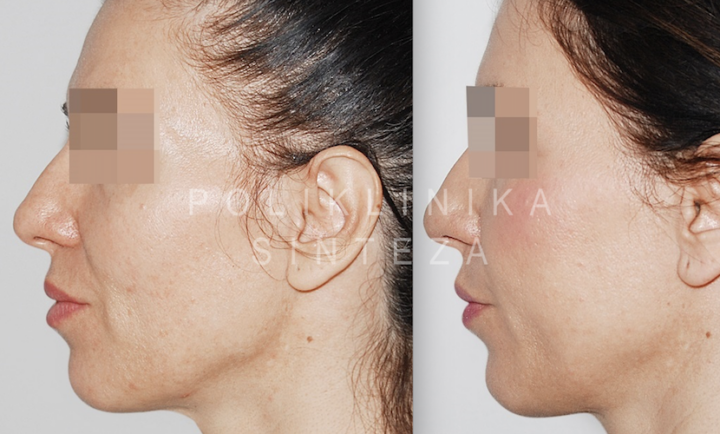
Nasolabial fold treatment with fillers or fat transfer
Treatment of nasolabial folds
Nasolabial folds run from the sides of the nose to the corners of the mouth. They can deepen and lengthen as the face loses firmness with age. To achieve a natural result, the clinician identifies where support and volume are needed.
Treating nasolabial folds with hyaluronic acid fillers
Rejuvenating this part of the face involves more than filling the lines around the mouth. Lifting the cheek restores support to the midface, where tissue can settle over the nasolabial folds and make them look deeper.
After examining the face, the doctor chooses a hyaluronic acid filler of the appropriate density. It is placed at selected points to lift the cheeks and soften the folds. Treatment takes around 30 minutes, with no specific recovery period. Redness, unevenness or bruising, if present, usually settles quickly.
Hyaluronic acid fillers break down naturally over time. Treatment may be repeated after nine to 12 months, often with considerably less filler than was needed at the first visit.
Treating nasolabial folds with fat transfer
Treatment aims to restore volume in the right place and lift the cheek. This can be done using a hyaluronic acid filler or the patient’s own fat.
Fat is collected from an area where it is more abundant, then transferred to the area being treated. The procedure takes about 60 minutes under local anaesthesia and is intended to give a natural-looking result. Mild facial swelling can occur and usually subsides on its own. The final result is visible after about a month.
Because transferred fat is absorbed more slowly, results generally last longer than those described for treatment of the under-eye area with hyaluronic acid fillers.
Results