Exercise Stress Test
What is an exercise stress test?
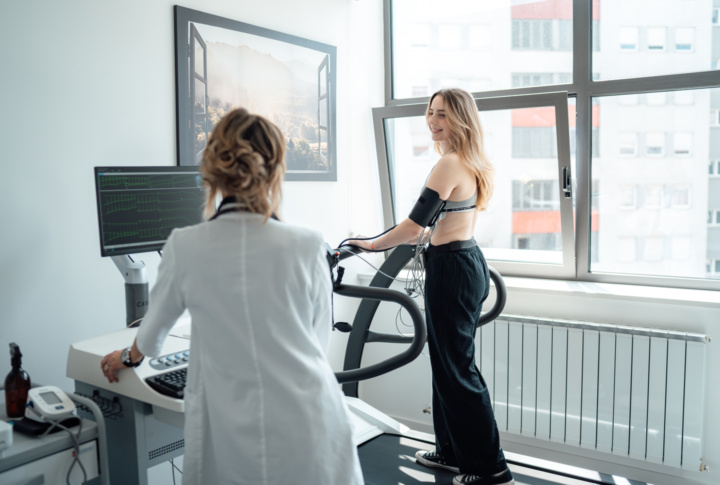
An exercise stress test assesses how well the heart copes with physical exertion during controlled exercise. An ECG is recorded and blood pressure is measured while you walk on a treadmill or pedal a stationary bicycle (ergometer). The ECG helps the doctor assess your heart rate, rhythm and the condition of the heart muscle.
Other names for this test include exercise testing, a cardiac stress test and ergometry.
During physical activity, the body needs more oxygen and the heart pumps blood faster.
The test helps identify problems with heart function that appear during exercise. It measures how much exercise you can tolerate and can provide indirect evidence of coronary artery disease, a narrowing of the vessels that supply the heart muscle with oxygen. During the test, you may notice symptoms, the ECG tracing may change, or an abnormal rhythm may be detected.
Contact us with confidence.
BOOK AN EXERCISE STRESS TESTWhen is an exercise stress test needed?
Your doctor may recommend an exercise stress test for several reasons
- suspected coronary artery disease, which may only become apparent when the heart is working harder and can be missed by tests performed at rest
- to detect heart disease when symptoms are mild, unclear or absent
- unexplained chest pain
- to monitor progress during cardiac rehabilitation
- to assess exercise capacity in professional athletes
What happens during an exercise stress test?
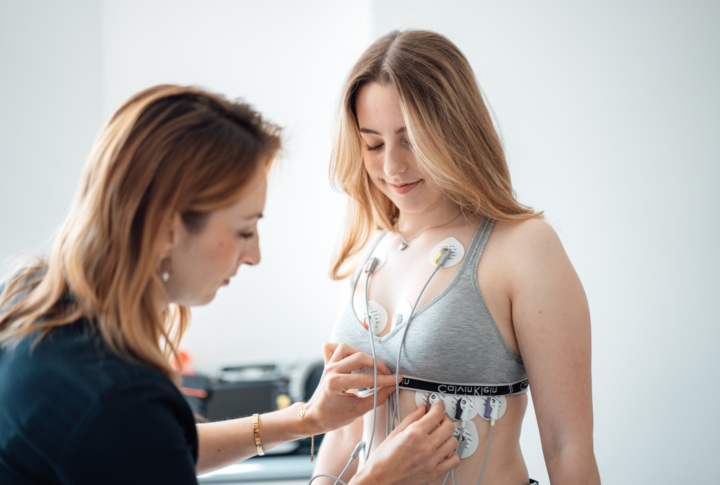
ECG electrodes are placed on your chest and a blood pressure cuff is fitted around your arm. The workload increases in stages every three minutes. Your doctor compares the results with reference values for your age and sex. After exercise, you rest for six minutes while the doctor monitors how quickly the readings return to their pre-test values.
During the test you may experience shortness of breath, a choking sensation, chest pain, skipped heartbeats, tiredness or dizziness. The test is stopped if symptoms become too pronounced or the ECG shows abnormal changes.
The report describes the workload you reached. The test may be maximal for your age and sex, submaximal if you remain below the predicted level, or limited by symptoms. Your doctor will explain the results and discuss the next steps with you.
When should an exercise stress test be avoided?
Exercise changes heart rate and blood pressure. These changes can be dangerous for some patients. The test must not be performed in the following circumstances
- acute conditions such as acute coronary syndrome within the past 48 hours, aortic dissection, myocarditis, pericarditis, pulmonary embolism or pulmonary infarction
- symptomatic aortic stenosis
- symptomatic cardiac arrhythmias
- acute heart failure
Extra precautions are needed when testing patients with any of the following conditions
- high-grade heart block
- abnormally slow or fast heart rhythms (bradyarrhythmias or tachyarrhythmias)
- blood pressure above 200/110 mmHg
- severe narrowing of a heart valve or of the left main coronary artery
- an electrolyte imbalance
Your doctor will postpone the test until it is safe to proceed, or may perform it with extra precautions if the expected benefit outweighs the potential risk.
Preparing for an exercise stress test
Avoid eating for three hours before the test. On the day of the test, avoid smoking, alcohol and caffeine, as these can affect the results.
Wear light, comfortable shoes and clothes suitable for walking on a treadmill. Choose clothing that makes it easy to uncover your chest and arms so the equipment can be fitted.
Bring any previous medical records, particularly cardiology reports, on the day of the test.
Recovery after an exercise stress test
Chest pain, dizziness, difficulty breathing or fatigue may occur during testing. You will be monitored for about 20 minutes afterwards so that any symptoms can settle and your heart rate and blood pressure can return to their normal range. You can then go home and resume your usual activities.
How much does an exercise stress test cost?
You can find the cost of the test in our current price list (in Croatian). For more information, call +385 1 5005 970 or email info@sinteza.hr
This service is provided at the location:
- For 16 years, the first choice for our clientsSinteza - Folnegovićeva


