Lower-Limb EMNG (Legs and Feet)
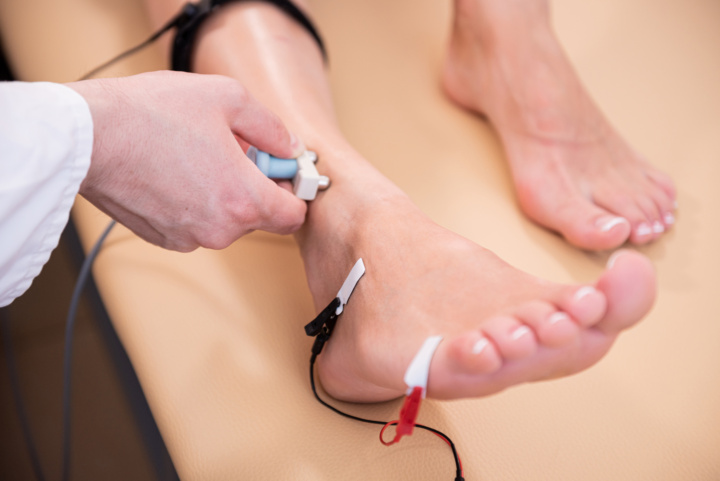
Leg EMNG, also called lower-limb EMNG, assesses the function of the nerves and muscles in the legs. It helps the doctor identify damage to a nerve root or peripheral nerve, problems with the way electrical signals travel along a nerve, or changes in muscle function.
One important advantage of EMNG is that it can help distinguish between a problem in a nerve root, a muscle or the junction between a nerve and a muscle. It is often used to investigate nerve entrapment, polyneuropathy and other muscle or neurological conditions.
At Sinteza Clinic, you can have lower-limb EMNG and see a rehabilitation medicine specialist or neurologist afterwards. Your doctor can recommend further tests or treatment based on the results.
What happens during lower-limb EMNG?
EMNG of the legs usually takes 30–45 minutes.
No special preparation is needed, but please arrive with clean skin. Avoid creams, lotions and similar products on your legs, as they can affect contact between the electrodes and your skin.
EMNG does not use radiation, contrast agents or sedation, and most patients tolerate it well. For these reasons, the clinicconsiders the test safe, and adverse effects are generally not expected.
Contact us with confidence.
BOOK A LOWER-LIMB EMNG
When is lower-limb EMNG recommended?
Lower-limb EMNG is recommended when symptoms suggest a problem with the nerves or muscles in the legs. These symptoms include
- persistent lower back pain,
- muscle weakness,
- pain,
- a burning sensation,
- difficulty walking smoothly,
- reduced sensation or tingling in the feet, toes, lower legs or thighs
Lower-limb EMNG can help detect several conditions, most commonly the following.
- a trapped nerve
- polyneuropathy
- peripheral nerve injury
- nerve root damage, for example as a result of a spinal condition
- muscle disease
- a disorder of the neuromuscular junction, where a nerve signals a muscle to move
What happens during an EMNG examination?
Lower-limb EMNG usually has two parts. The first is a nerve conduction study (electroneurography), which measures how a nerve responds to stimulation and conducts electrical signals.
During this part, electrodes are placed on the skin. Brief, mild electrical pulses are delivered to the nerve to measure how quickly and how well it conducts signals. This may be uncomfortable, but most patients do not describe it as very painful.
The second part iselectromyography, which records muscle activity. A fine needle is inserted into selected muscles to record their electrical activity at rest and during movement. This can cause brief discomfort or mild pain, but the test is short and generally well tolerated.
Taking a pain reliever such asibuprofen or naproxen30–45 minutes before the test may help reduce pain or discomfort during the examination.
How should I prepare for the test?
Lower-limb EMNG requires no special preparation, but please arrive with clean skin. On the day of the test, avoid applying creams, lotions, oils or powders to your legs, as they can interfere with the electrodes.
If you have had lower-limb EMNG before, bring your previous medical records so the results can be compared.
Tell the clinic before your appointment if you take medicines that affect blood clotting or have an implanted pacemaker.
Risks and possible complications
EMNG is a low-risk test, and serious complications are very rare. After the needle examination, you may havetemporary tenderness, a small bruise or mild painin the muscle.
Very rare complications include bleeding, infection or nerve injury at the needle insertion site. At Sinteza Clinic, strict hygiene and disinfection procedures for all equipment make these complications extremely unlikely. A trained medical team performs the test to maintain the quality of care and reduce the risk of nerve injury.
Serious complications after lower-limb EMNG are very rare. Most people can return to their usual activities immediately after the test.
Recovery after EMNG
There is no special recovery period after EMNG. Any minor bruising or muscle soreness usually settles on its own within a short time.
If you have pain,a pain reliever after the testcan help. Most patients can get back to work, driving and everyday activities straight away.
How much does lower-limb EMNG cost?
The fees for lower-limb EMNG and other services atSinteza Clinicare listed in ourprice list (in Croatian).
Frequently asked questions
Does EMNG hurt?
The brief electrical pulses and the fine needle used to test the muscles may cause mild discomfort, but most people tolerate the examination well.
Can EMNG show whether the problem comes from the spine?
EMNG can help identify nerve damage or irritation caused by a spinal problem, such as a herniated disc pressing on a nerve root.
The results are always interpreted alongside your symptoms, the clinical examination and any other tests that are needed. A rehabilitation medicine specialist or neurologist will advise you on further investigations and treatment.
How long does the test take?
Lower-limb EMNG usually takes 30–45 minutes, although it can sometimes take longer.
Is there a recovery period?
There is no special recovery period. Most patients resume their usual activities immediately. Some develop mild bruising or swelling, which usually settles quickly.
When will I receive my results?
You receive the results the same day, immediately after the examination.
This service is provided at the location:
- DIAGNOSTIC CENTER - MAGNETIC RESONANCE WITHOUT WAITINGSinteza - Vrbanićeva

